Saint-Émilion
Saint-Émilion is an ancient wine-growing territory, shaped by overlapping soils, practices and successive interpretations.
Its identity has been built over time, through use rather than discourse.
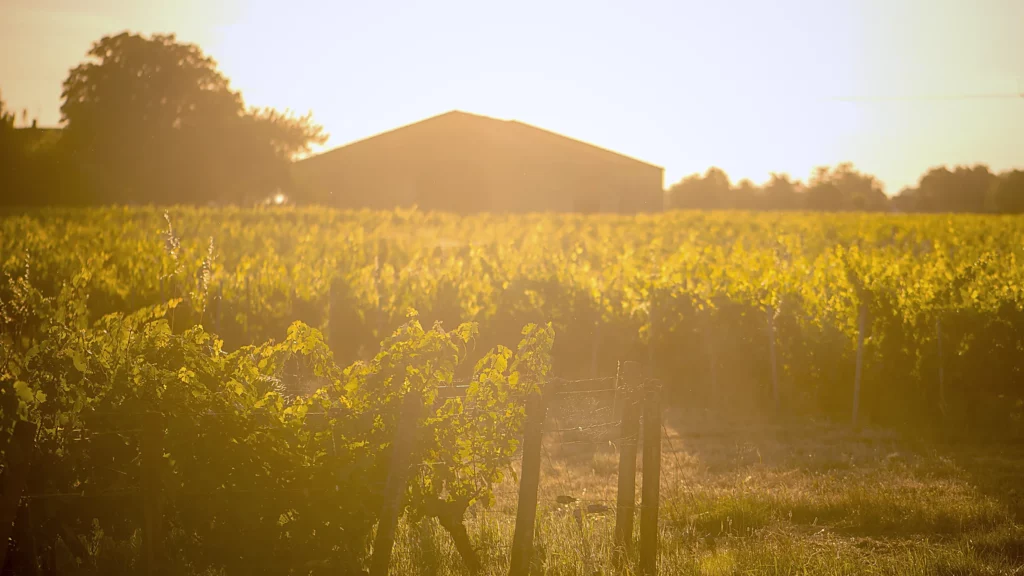
The appellation encompasses a wide diversity of situations, styles and approaches.
It cannot be reduced to a hierarchy or a single aesthetic, but to a way of working vine and wine within a defined framework.
A structuring landscape
The landscape of Saint-Émilion is marked by slopes, plateaux and gentle inclines, whose exposures and soils condition grape maturity and wine balance.
This diversity requires choices, adaptations and constant attention to place.
A classical reading
Château Belle Grange follows a classical reading of the appellation.
An approach where precision, restraint and readability prevail over effect or claimed singularity.
Wine is conceived as a faithful translation of place, without seeking to depart from the framework of Saint-Émilion.
Time and regularity
In Saint-Émilion, time plays a central role.
The time of the vintage, the time of ageing, the time of evolution.
This temporality calls for restraint, continuity rather than rupture, and trust in duration as a measure of accuracy.
Appellation continuity
Saint-Émilion is not a backdrop.
It is a demanding framework that requires consistency and coherence.
Château Belle Grange is part of this continuity, producing wines attentive to the balance and rhythm of the appellation.